
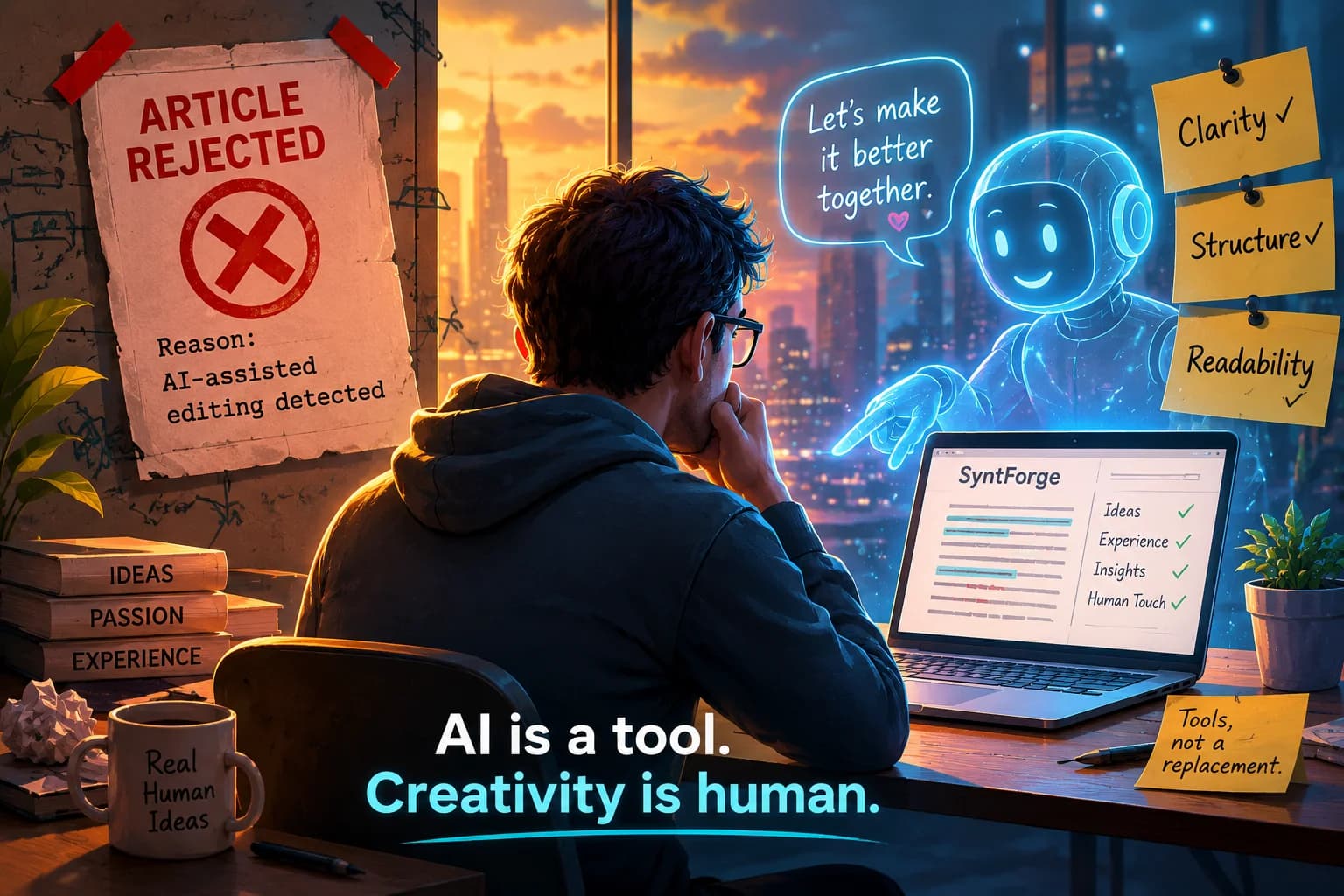
My Article Was Rejected Because I Used AI. It Made Me Think.

Synt Forge
@syntforge
My Article Was Rejected Because I Used AI. It Made Me Think.
Recently, I decided to start documenting the development of my project, SyntForge.
My goal was simple: openly share the journey of building a platform from scratch—the ideas that worked, the mistakes that didn't, the architectural decisions, the experiments, and everything learned along the way.
I wrote my first article the same way many developers work today.
I drafted it myself, then used AI to improve the structure, fix grammar, polish the wording, and make it easier to read.
The article was rejected.
The reason? AI-assisted editing.
That made me stop and think.
Where Do We Draw the Line?
Artificial intelligence is no longer a novelty.
It's becoming part of everyday work.
Developers use GitHub Copilot, ChatGPT, Claude, and other AI assistants.
Designers work with Midjourney, Flux, Firefly, and countless other generative tools.
Musicians experiment with AI-generated audio.
Video editors rely on AI for subtitles, noise reduction, object removal, and smart editing.
Translators use AI daily.
Even the way we search for information is changing—many people now ask an AI before opening a search engine.
AI has become another tool in our toolbox, much like IDEs replaced plain text editors, Git replaced ZIP archives, and search engines replaced shelves of technical books.
We don't question a developer's skills because they use code completion.
We don't dismiss a designer because they use Figma instead of drawing everything by hand.
We don't think less of a photographer for editing images in Lightroom.
So why should using AI to improve the clarity of a written article be treated differently?
The Difference Matters
There is an important distinction.
One person asks AI to generate an entire article, publishes it without verification, and presents it as original expertise.
Another person writes the article themselves, while AI simply acts as an editor—improving readability, correcting grammar, removing repetition, and helping organize ideas.
In the second case, the thoughts remain human.
The experience remains human.
The insights, mistakes, and conclusions all belong to the author.
Only the presentation improves.
In many ways, AI is simply a modern version of spell-checking or working with a professional editor.
We Already Live in a Different World
Every technological shift is met with skepticism.
When calculators appeared, people worried nobody would learn math anymore.
When the internet arrived, people said independent thinking would disappear.
When search engines became mainstream, many believed memory itself would become unnecessary.
Today, we're having similar conversations about AI.
History tends to repeat itself.
New tools don't replace expertise.
They raise the standard.
A great developer isn't defined by writing every line of code without assistance.
They're defined by making good engineering decisions.
A great designer isn't the one who places every pixel manually.
They're the one who creates meaningful products.
And a great writer isn't someone who refuses to use AI.
They're someone who has something worth saying.
What I Wanted to Write About
The SyntForge blog was meant to be completely transparent.
Not just about successes.
But about failures.
About technical decisions.
About architecture.
About community building.
About product development.
About growing a platform from an idea into something real.
I believe this kind of honest, practical experience is exactly what other developers and builders find valuable.
Final Thoughts
I understand why platforms want to fight low-quality, AI-generated content.
There is certainly too much of it.
But perhaps we've reached a point where we should judge the value of an article—not whether AI was involved in polishing it.
If the ideas are original...
If the experience is real...
If the lessons come from the author...
Does it really matter who helped fix the grammar or improve the flow?
AI has already become part of our daily workflow.
Maybe the question is no longer:
"Did the author use AI?"
Maybe the better question is:
"Does this article contain genuine human insight?"
For me, that's what truly matters.
Comments (0)
No comments yet. Be the first!